Showing posts with label guide. Show all posts

Photography in Iceland - A Snapshot of Nature

You've framed the composition. Jagged volcanic rock formations are silhouetted against the crystal glacier horizon. Looking up from the viewfinder of your SLR, reality is confirmed; you are standing shrouded in the ethereal glow of the emerald and violet Northern Lights.

Photography in Iceland - A Snapshot of Nature

Snap!

It's little wonder why Iceland is seen as the photographer’s paradise. For the seasoned professional or the so inclined amateur enthusiast, there is no shortage of subject matter. With contrasting landscapes covering the island, each one more breathtaking than the last, Iceland is a photographer’s dream destination; from the charming small town islands of Vestmannaeyjar, to the enchanting scenes of nature at the Golden Waterfalls of Gullfloss, your individual photography fairy-tale awaits.

Photography in Iceland - A Snapshot of Nature

Iceland itself is a unique mix of cultures and traditions that have been refined by a beautiful, yet demanding, landscape. Those who visit cannot help but want to capture a small piece to take home with them. Even those who aren’t normally ‘shutter bugs’ suddenly find a desire to pick up a telephoto lens, a small pocket digital shooter or even a phone, to capture one of the many scenes that touch their imaginations.

Memories preserved on film serve to awaken the spirit of adventure in every naturalist and call one back to the island’s majestic scenes (even for a second to third visit).

Photography in Iceland - A Snapshot of Nature

Inspired photographers of all skill levels set out into the wilds of Iceland to capture that perfect shot. Iceland may be small, but it has so much to offer in terms of variety. The unique and simple beauty on the island gives photographers the chance to shoot assorted subjects that are suited to every individual’s photographic flare; scenes of nature, wildlife, culture, midnight sun, Northern Lights… you’ll be sure to find your picturesque opportunities in Iceland!

Photography in Iceland - A Snapshot of Nature

Some quick facts! Iceland has very few trees, making unimpeded wide shots featuring wild, rocky terrain commonplace. Around 11.5% of the country is covered in glaciers. Amazing glass-like structures protruding from the foreground and cascades of ancient ice slides rolling through the mountains are some of the more remote, yet fantastic scenes on the island nation.

In summertime, specifically in June and July, the island experiences 24 hours of day light. The merging of sunrise and sunset make for some magical images of glaciers, beaches or waterfalls bathed in pink and orange light.

Photography in Iceland - A Snapshot of Nature

Wildlife

For wildlife photographers, Iceland boasts a rich birdlife. Puffins are exceptionally popular models. Stunning bird cliffs can be found around the country with breathtaking sunsets over the sea in the distance. The Icelandic horses provide a graceful subject, if not a tricky one; better snap fast, those ponies are quick!

Photography in Iceland - A Snapshot of Nature

Whale watching is a popular attraction that doesn’t disappoint. No need to take long trips out to sea, the huge water-dwelling mammals swim very close to the Icelandic coast. If you feel more like capturing images of domestic animals, there are also plenty of sheep and cows - in fact, the sheep outnumber the people 2 to 1! Of course, Iceland is also famous for Santa’s flying friends. Reindeer herds roam freely in some areas.

Northern lights photography in Iceland

In addition to Iceland’s night life, there are the “night lights”. The Northern Lights are another natural wonder that is unique to regions lying in the Arctic Circle. Streaking the night’s sky with vivid color, the Arora Borealis can best be seen in the winter months away from populated areas.

Photography in Iceland - A Snapshot of Nature

The sight of the northern lights were considered a sign of something sacred to the Norse people; seeing the breathtaking sight today, it is easy to see why.

Culture 

There is no place better for quirky images of culture, food, architecture or people than Reykjavík! It is known for its colorful houses, arts, great nightlife and a personality all of its own. The Icelandic population is a mix of Scandinavian as well as Irish heritage, which is reflected in their food, architecture, and character. Dotted around the coastline of the country are a few towns and numerous small fishing villages. Some are very remote and in idyllic settings. The traditional turf houses are small cottage structures covered with earth and make for a rustic, quaint picture.

Photography in Iceland - A Snapshot of Nature

Iceland’s individuality, diversity and remoteness are what make it such a desirable destination for the amateur or the professional photographer. From its natural wonders, to its animal life and the people who call it home, this island nation has so much to take in, and so much to capture on film. One thing is for sure, on your next Icelandic adventure, you shouldn’t forget your camera!

Photo tours and photo workshops in Iceland

Iceland24 can get you in touch with the talented Florent Gast (info@landmannalaugartours.com), a fully licensed tour operator in Iceland.

Florent Gast is a fantastic photographer that has years of experience in photographing Icelandic nature and both organizes photo tours and workshops in photography. The workshops are small and personal and include information about long exposure methodology, concepts of landscape photography, visual design and composition, working with filters, post processing for web and prints, basics of time-lapse and more.

Photography in Iceland - A Snapshot of Nature

All the pictures in this article (and most of the pictures on this website) are taken by Florent, many of them during photo tours, such as this one that appeared recently in The Icelandic Times.

Photography in Iceland
Rachel - Iceland24
July 2014

Surfing in Iceland? Icelandic surf guide

While surfers have been wandering the globe in search of perfect waves for a solid 50 years now, until recently, in order for a place to be considered a surfing mecca it had to meet the idyllic tropical threshold: swaying palms, warm water, powder-white beaches. It’s no wonder places like Tahiti, Fiji, and Indonesia have well-beaten paths. But true adventurers are always on the frontier, which, in surfing circles, is getting pushed farther and farther away from the equator.


This movement has been fueled largely by incredible advances in wetsuit technology. Softer, lighter, more flexible rubbers that have been developed in Japan have been incorporated by every major wetsuit manufacturer, and subsequent advances in fit and ergonomics have dramatically improved comfort for surfers in cold locales. Today, a place like Iceland, which was once considered impossible to surf, is suddenly on the surf-adventurers map.


California’s Chris Burkard is one surfer who never let the cold stop him. “I grew up on the Central Coast of California, which has chilly water year-round, so that part never intimidated me,” he said. As a staff photographer for Surfer magazine, he doesn’t mind volunteering for assignments in the northern reaches. “Surfers are always wondering where the next perfect wave is going to be found, and there are still a lot of warm-water discoveries to be made, but the bottom line is there’s way more unexplored coastline up where things get cold and rugged, and that’s what lured me to Iceland,” he said.


While he’s only made a few trips to the Nordic island, what Burkard has found will keep him going back for years to come. “I’m a lover of the outdoors, and this is wilderness surfing at its finest,” he said. Here are some of his images from his most recent visit.


“There are very few places in the world where you can find ice on the shores of a beach with perfect surf. Walking around huge glacial ice chunks on the way to the water there was no question this was going to be the coldest session of our most recent trip to Jökulsárlón,” Burkard said.


“In summer the water can be a toasty 47 degrees. But in the fall, when the swells get bigger, water temps drop into the high 30s.”


Sam Hammer has been surfing through New Jersey’s harsh winters for nearly 20 years, so he’s used to pretty chilly water. But you won’t find a scenic lineup like this anywhere near the Jersey Shore.


“We spent days wandering in places where you don’t even see signs of civilization,” explains Burkard. “I brought a Goal Zero solar pack just to keep my camera charged, and it quickly became the most prized possession within my crew, because everyone had gadgets that needed charging. Little things like that can become your lifeline.”


Driving is both heaven and hell in Iceland, but the scenery is always changing. One minute you’re on a black sand beach, the next a giant white glacier, and and hour later a sea of green.


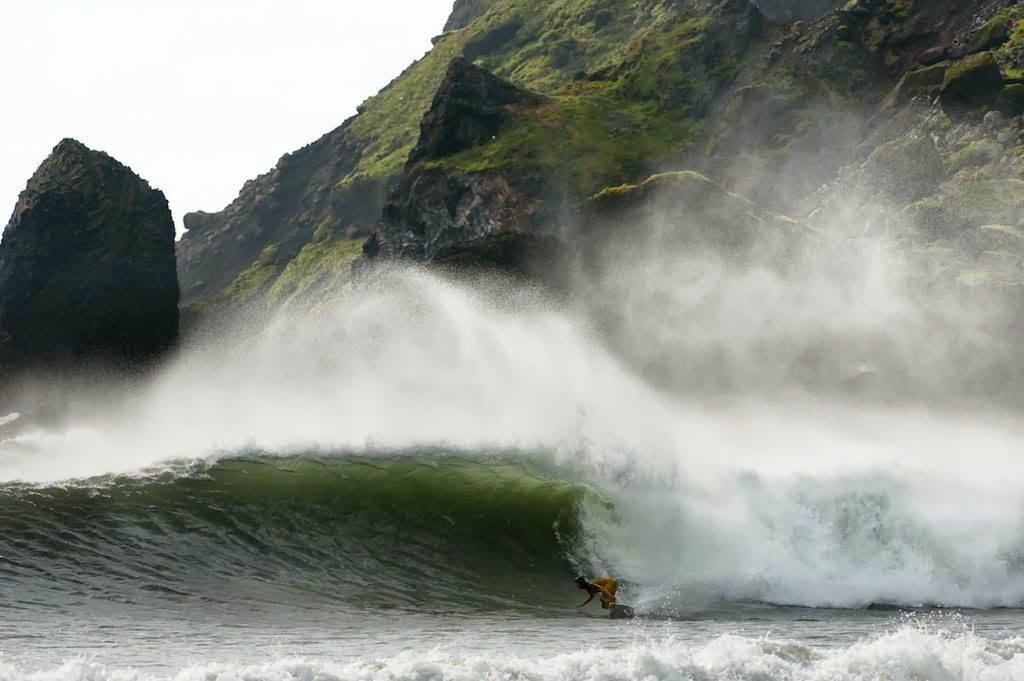
Shooting photos from the water in Hofn was surreal. “It was hard to imagine we were scoring waves at the foot of some of the most dramatic mountains I’ve ever seen,” said Burkhard. With the air temperature dropping below the water temp on this day, “The water felt surprisingly nice,” he added.


A decade ago wetsuits were so stiff and heavy guys like Alek Parker wouldn’t have stood a chance of being able to perform like this. Today’s suits have improved dramatically, allowing for a lot more fun, and opening the door for a lot more exploration.


The best part of wilderness surfing like this is you get your pick of camp sites. Burkard and his crew always go for the ones with a view.


Advances in technology are pushing surfing's frontier farther and farther away from the equator


When to go?

Low pressure systems spawned in Baffin Bay, wind up south of Greenland, before sending groundswells slamming into the Reykjanes peninsula, the first stop on the transatlantic swell highway. These swells can be giant and very powerful, building suddenly and they are often accompanied by raw winds and stormy conditions.


Winter is the most consistent swell season with excellent waves regularly hitting all sides of the Reykjanes. The problem in mid-winter is getting the right conditions to conspire in the very short span of daylight. Strong winds, chilling temperatures, snow storms and large tidal fluctuations are just some of the variables. September to November can be good months, with manageable air and water temperatures, and frequent low pressures.


May-August sees plenty of summer flat spells in the southwest and could be a good time to explore the east and the north coasts for arctic wind swells. Tides exceed 5m (15ft) and there are only a few spots that can handle all tide heights. Even the main beachbreak at Sandvik struggles to break at high tide.

Source: Grindtv.com / Christopher Mauro
Iceland24, August 2014

Travel in Iceland: Europe's biggest national park is in Iceland

In 2008, Iceland embarked on a nature conservation project on a hitherto unparalleled scale with the establishment of the 12,000 sq km Vatnajökull National Park. Few if any regions in the world offer such a mixture of dynamic ice cap and outlet glaciers, geothermal energy and frequent subglacial volcanic activity, coupled with outburst floods.


Initially, the park will include some areas already under protection, such as the Skaftafell and Jökulsárgljúfur National Parks, Lónsöræfi wilderness and Vatnajökull glacier, which is larger than all the other glaciers in Europe combined. Already occupying about 12% of the country, the park boundaries are expected to expand in the coming months and years, so as to offer a unique opportunity to observe the wide-ranging impact of the Vatnajökull glacier on its surroundings, in which ice and fire play leading and often complimentary roles.


The park is the single largest nature conservation project the Icelanders have ever undertaken. Moreover, it marks one of the largest economic and rural development schemes that the government has implemented in Iceland. Tourists visiting this protected area will be able to observe the culture and history of the communities dotted around the glacier, which have learned through the ages to live with and utilise their volatile surroundings. The proximity to nature’s land-sculpting elements opens up boundless possibilities for research and study visits, and not least for experiencing the silence and solitude of the wilderness and thus feeling at one with nature.


Visitor Centres are the park’s core service facilities and will be based at the national park’s main entrance points. Two already exist and four more will be added (Campervan Sweden). They contain exhibitions and displays, provide information and host various cultural events, as well as housing the park wardens.

Wardens offer guided nature interpretation tours and children’s activities in different parts of the park, providing an insight into the area’s natural wonders, from volcanic eruptions and catastrophic floods at the grander end of the scale, to the delicate world of Iceland’s fragile flora and fauna.

Iceland24
May 2013