Iceland has surprisingly few islands big enough to explore and/or live on. This probably has something to do with how the country was made. The islands we do have, however, add a little bit of extra adventure to any exciting holiday in Iceland.
Iceland’s neighbours across the sea in places like Scotland and Norway seem to be absolutely awash with islands; but then they are physically older landmasses where erosion has been busily breaking up the rocks and currents have consistently been piling up sand and silt into monumental mounds – many of which are now islands.
Iceland, on the other hand, is a volcanic land still being created from a seam between tectonic plates as they move apart. As the lava bubbles up to fill the gaps, we are left with a remarkably circular shaped country, compared to most. As well as this, the forces of nature have not had a very long time to work on island building so far.
Iceland can boast about 30 so-called ‘big islands’ ranging from 13.4 sq. km down to 20 sq. m. We have thousands of rocks and skerries as well, but they are classified as ‘small islands’ and not therefore counted.
Of Iceland’s 30 main islands, nine are of particular interest and can be visited, or viewed from offshore. That number is ten, if you include the island of Iceland itself…Here they are:
1. Heimaey
This is the only one of South Iceland’s Westman Islands (Vestmannaeyjar) which is inhabited by humans. Actually the island has one of Iceland’s bigger towns on it and is worth visiting just for that. But Heimaey is famous for two things above all else: puffins and the big scary 1973 volcanic eruption. The former nest on the island in numbers not seen anywhere else on the planet and the latter kept the islanders away from home for nearly seven months and destroyed a lot of houses. Now you can explore some of those houses, Pompeii style.
2. Hrísey
This delightful, peaceful little island is full of history and has been permanently inhabited since the settlement of Iceland. It is the second biggest island off the mainland and only 15 minutes’ ferry ride from the mainland. The island is today part of the Akureyri municipality and its 170 inhabitants are mostly famous for the seafood they create – especially the beautiful mussels.
3. Grímsey
A fair way further offshore out to the north lies Grímsey – famous mostly for being the only part of Iceland to cross the Arctic Circle*. It’s one of those little human landmarks that we like to go to. See the line. Jump over the line. Jump back again. Take a photo straddling the line. You know how it goes. Fishing and tourism are the 90 inhabitants’ main livelihood.
4. Viðey
Viðey is less than five minutes by boat from Reykjavík. It has a lovely cliffy beach to explore, a small adventure playground, a café and the renowned Lennon Ono Imagine Peace Tower, which is very much worth seeing, even when the lights are turned off.
5. Surtsey
Surtsey is another one of the Westman Islands. Although it wasn’t before 1963. The volcanic eruption that created the island lasted until 1967 and Surtsey has been a natural laboratory ever since, allowing scientists to study how life colonises new land. As a result, you can’t go there. Sorry. But you can get close to it on a boat.
6. Flatey
Flatey in Breðafjörður is the quintessential image of rural Icelandic charm. The green agricultural island has a winter population of just five people, but many more in the summer. The ramshackle, but welcoming village was the set for the Icelandic comedy film Brúðgumminn. The ferry between Snæfellsnes and the Westfjords stops at Flatey and it makes a great overnight stopover.
7. Vigur
Vigur island is one of the Westfjords town of Ísafjörður’s biggest attractions. The island is not in the town, but the ferry departs from there… Vigur is famous for the quality of the farmer’s cakes and waffles, for having the smallest post office in Europe, and for its eider ducks, which are quite unafraid of people and provide some of the world’s most valuable and sought after eider down.
8. Kolbeinsey
This is one you almost certainly can’t visit. It is a tiny rock way above the Arctic Circle famous for nothing more than being Iceland’s northernmost point. In the name of frontier building and political shenanigans, Iceland built a helipad on the rock – which is almost the same size as the whole island. By regularly landing Coastguard helicopters on the island, Iceland proves its sovereignty of the island. At least that was the idea before the helipad crumbled into the sea. The whole island may not be far behind it.
9. Lundey
Lundey is another one just off the coast of Reykjavík, and another one you unfortunately can’t go and walk on. But if you take a whale watching tour, there is a very big chance you’ll stop very close to the island to observe all the nesting puffins from a safe distance. The island’s name means Puffin Island – and that’s precisely what most tour guides call it.
Source: Wow Magazine
Iceland24, April 2014
Moustache March in Iceland
For the third year running, men in Iceland are encouraged to grow moustaches this March to raise awareness for the Icelandic Cancer Society.
If you visit Iceland in March don’t be alarmed by all the rugged male handsomeness and the incredible number of moustaches going around.
Icelanders grow their moustaches in March for a good causeIn most countries, November is a time for growing your moustache for a good cause. Icelanders, always trying to do things a little differently, use March for their moustache growing. Because this is such a small island this trend really catches on so the number of moustaches becomes monumental during this time.
Some grow it just to fit in but others to compete, either solo or in teams, and raise funds for cancer research. Overall, this fun event encourages men of all ages to talk about the dangers of cancer with each other and get checked out.
Ragnheiður Haraldsdóttir, director of the Icelandic Cancer Society, told RÚV that their goal is to raise 35 million ISK this month. Men are encouraged to grow moustaches this month to show their support for the drive - the more visible moustaches, the more visible support, which then hopefully leads to more donations.
She says that the goal of raising about one million crowns per day might seem high, but the Icelandic Cancer Society intends to make a large promotional effort for the drive, a great deal of it happening on the internet. Moustache March is a crucial part of that drive.
Ragnheiður points out that many people try to raise money by making their own products for sale, whatever they may be. The important thing about the event is to make it fun, from beginning to end.
If you are a male in Iceland of moustache-growing capacity, you are hereby encouraged to leave your upper lip alone this month.
Berglind Rós, Iceland24
March 2014
If you visit Iceland in March don’t be alarmed by all the rugged male handsomeness and the incredible number of moustaches going around.
Icelanders grow their moustaches in March for a good causeIn most countries, November is a time for growing your moustache for a good cause. Icelanders, always trying to do things a little differently, use March for their moustache growing. Because this is such a small island this trend really catches on so the number of moustaches becomes monumental during this time.
Some grow it just to fit in but others to compete, either solo or in teams, and raise funds for cancer research. Overall, this fun event encourages men of all ages to talk about the dangers of cancer with each other and get checked out.
Ragnheiður Haraldsdóttir, director of the Icelandic Cancer Society, told RÚV that their goal is to raise 35 million ISK this month. Men are encouraged to grow moustaches this month to show their support for the drive - the more visible moustaches, the more visible support, which then hopefully leads to more donations.
She says that the goal of raising about one million crowns per day might seem high, but the Icelandic Cancer Society intends to make a large promotional effort for the drive, a great deal of it happening on the internet. Moustache March is a crucial part of that drive.
Ragnheiður points out that many people try to raise money by making their own products for sale, whatever they may be. The important thing about the event is to make it fun, from beginning to end.
If you are a male in Iceland of moustache-growing capacity, you are hereby encouraged to leave your upper lip alone this month.
Berglind Rós, Iceland24
March 2014
Jökulsárlón glacier lagoon in Iceland. An adventure you'll never forget!
Jökulsárlón is today one of Iceland's best known and most popular natural wonders, and for a good reason. A magnificent view welcomes you as you arrive there and it's almost like stepping into a fairy tale landscape.
Jökulsárlón (literally "glacial river lagoon") is a large glacial lagoon in southeast Iceland, on the borders of Vatnajökull National Park. Situated at the head of Breiðamerkurjökull, it evolved into a lagoon after the glacier started receding from the edge of the Atlantic Ocean.
The lake has grown since then at varying rates because of melting of the Icelandic glaciers. The lagoon now stands 1.5 kilometres away from the ocean's edge and covers an area of about 18 km2. It recently became the deepest lake in Iceland at over 248 metres depth as glacial retreat extended its boundaries.
The size of the lagoon has increased fourfold since the 1970s. It is considered as one of the natural wonders of Iceland. The lagoon can be seen along Route 1 between Höfn and Skaftafell. It presents a picturesque parade termed as “A ghostly procession of luminous blue ice-bergs through the 17 km2 Jokulsarlon Lagoon”. Jökulsárlón has been a setting for four Hollywood movies - A View to a Kill, Die Another Day, Tomb Raider and Batman Begins - A postage stamp depicting Jökulsárlón was issued in 1991 with a face value of 26 krónur.
The tongue of the Breiðamerkurjökull glacier is a major attraction for tourists. Tour operators conduct snowmobiles and jeep tours to visit the glacier along the winding iceberg studded Jökulsárlón Lagoon. The base station for visits to the area is at Joklasel, which is approached from Höfn. It is termed as Tourist Conveyor belt.
FAUNA
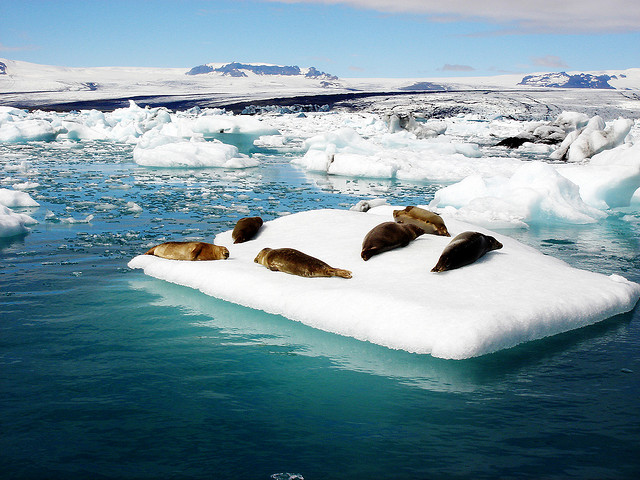
The lagoon is filled with fishes that drift in from the sea along with the tides. Seals gather in large numbers at the mouth of the lagoon to catch fish during the winter, which is a sight to watch. Large numbers of sea birds, particularly arctic terns, which nest nearby also gather to catch herring, trout, salmon and other fishes and krill.
LANDSCAPE
The white cap of Breiðamerkurjökull glacier dominates the lagoon and its icebergs. Jökulsárlón is separated from the sea by only a short distance, and the combined action of the glacier, the river that empties from the lake, and the ocean may eventually transform it into an inlet of the sea. There are plans to prevent this from happening, since the only road in the area passes over the narrow isthmus.
HOW TO GET THERE
Sterna (buses)
Jokulsarlon-Skaftafell
Reykjavik-Laugarvatn-Reykholt-Gullfoss-Geysir
Reykjavik-Hofn
Reykjavik-Hvolsvollur-Vik
Reykjavik-Arnes-Fludir
Vatnsmyravegur 10
101 Reykjavik
Tel.: 562-1011
bogf@bogf.is
More information about Vatnajökull Region
Jókulsárlón panoramic view
Berglind Rós
Iceland24
Mars 2014
Jökulsárlón (literally "glacial river lagoon") is a large glacial lagoon in southeast Iceland, on the borders of Vatnajökull National Park. Situated at the head of Breiðamerkurjökull, it evolved into a lagoon after the glacier started receding from the edge of the Atlantic Ocean.
The lake has grown since then at varying rates because of melting of the Icelandic glaciers. The lagoon now stands 1.5 kilometres away from the ocean's edge and covers an area of about 18 km2. It recently became the deepest lake in Iceland at over 248 metres depth as glacial retreat extended its boundaries.
The size of the lagoon has increased fourfold since the 1970s. It is considered as one of the natural wonders of Iceland. The lagoon can be seen along Route 1 between Höfn and Skaftafell. It presents a picturesque parade termed as “A ghostly procession of luminous blue ice-bergs through the 17 km2 Jokulsarlon Lagoon”. Jökulsárlón has been a setting for four Hollywood movies - A View to a Kill, Die Another Day, Tomb Raider and Batman Begins - A postage stamp depicting Jökulsárlón was issued in 1991 with a face value of 26 krónur.
The tongue of the Breiðamerkurjökull glacier is a major attraction for tourists. Tour operators conduct snowmobiles and jeep tours to visit the glacier along the winding iceberg studded Jökulsárlón Lagoon. The base station for visits to the area is at Joklasel, which is approached from Höfn. It is termed as Tourist Conveyor belt.
FAUNA
The lagoon is filled with fishes that drift in from the sea along with the tides. Seals gather in large numbers at the mouth of the lagoon to catch fish during the winter, which is a sight to watch. Large numbers of sea birds, particularly arctic terns, which nest nearby also gather to catch herring, trout, salmon and other fishes and krill.
LANDSCAPE
The white cap of Breiðamerkurjökull glacier dominates the lagoon and its icebergs. Jökulsárlón is separated from the sea by only a short distance, and the combined action of the glacier, the river that empties from the lake, and the ocean may eventually transform it into an inlet of the sea. There are plans to prevent this from happening, since the only road in the area passes over the narrow isthmus.
HOW TO GET THERE
Sterna (buses)
Jokulsarlon-Skaftafell
Reykjavik-Laugarvatn-Reykholt-Gullfoss-Geysir
Reykjavik-Hofn
Reykjavik-Hvolsvollur-Vik
Reykjavik-Arnes-Fludir
Vatnsmyravegur 10
101 Reykjavik
Tel.: 562-1011
bogf@bogf.is
More information about Vatnajökull Region
Jókulsárlón panoramic view
Berglind Rós
Iceland24
Mars 2014
Subscribe to:
Posts (Atom)