Santorini - Holidays to Santorini - Places To Visit -Travel Advice
Santorini, the most beautiful island in Greece and a true paradise in white and blue. Santorini is an island of the Cyclades in the Aegean Sea, located 200 km from Athens. Must go on holidays to Santorin and has a many places to visit in Santorini. Can arrive by plane in less than an hour from Athens, but the mode of transport most used and favorite is the boat.
The island is invaded by daily cruises that drop their passengers on ships and boats unable to dock vessels in the ports of the island The Island is unique and completely different from all the Greek islands but could not escape the ultra urbanization. Housing is very expensive, but paradise is priceless.
The capital is the town of Thira and its main port is Acinios (Athinios) quite out of Thira. There are many Orthodox churches in this small territory, the guide told us that families built their own church, explaining because there are so many places of worship. The roads are narrow and winding, a real danger and an adventure I do not recommend to heart. The rise of the harbor to the island is traumatic but the views are unparalleled, and are highly valued for the driver.
The sunken caldera of the volcano separates the main island Fira crescent-shaped with the other 4 beautiful islands (Thirassia is inhabited only as Fira). Today is one of the main tourist destinations in Europe and has a night (not as exaggerated as their neighbor Mykonos).
Weather in Santorini - The Island’s weather is perfect for tourists with very hot and sunny, but very dry and arid, creating the problem of water supply. Its soil is mostly volcanic and the landscape is wild, but very favorable for grapes and wine. It has many volcanic beaches all to enjoy, and hot springs. We also find many houses originally dug by the inhabitants.
Views of the caldera from Fira - Tips - If you are only one day dedicate everything to Oia, which is really a paradise and you can buy very nice gifts. In Fira better walk down the stairs instead of waiting for the endless queue of the funicular, although at first it is overwhelming.
Oia - Santorini - is for me the most beautiful Santorini, a quiet town nestled in a cliff overlooking unique.
Time seems to have stopped and in this wonderful town where you can enjoy the sunset and the most beautiful sunset in the world.
Walking through its streets are a maze where we lose our joy, we can admire the stately homes and palaces of white with blue roofs on a precipice, or their churches. You can find many jewelry artisan shops, typical gifts such as bracelets, dolls, paintings whose prices are more attractive than Fira.
It also has bars and restaurants with terraces where a drink, not without first looking at the prices (avoid surprises).
Fira - Santorini - is on the edge of a precipice. It has more terraces, its houses and narrow streets. We visit the two Cathedrals, the Orthodox Metropolitan Cathedral and the Catholic Cathedral. Access from its port can be by cable car or on foot. The descent advises walking and avoids the trauma of the poor animals.
On the island in addition to its two main villages, we visit the archaeological routes with their deposits. There are many archaeological remains found under volcanic ash, or from the port of Fira access the other islands by boat, to Nea Kameni with hot water, to Palea Kameni and volcanic stone beach, the beautiful neighboring Thirassia copy Santorini's most authentic and surprising island of Aspro.
Where to eat? - You can eat on the terraces of the restaurants in Oia and Fira and enjoy the views. But Oia is quieter and more economical choice than Fira. Also in Armeni are typical fish taverns.
On the local cuisine to comment on what little I know. Obviously we can enjoy seafood of course. Autochthonous wine also divided into two categories, white and Vinsanto (sweet wine). Widened be stressing the Octopus, the Greek salad, tzatziki, the taramosalata but I fall short. And with coffee frappe take a Ouzo, the traditional Greek liquor.
I could write endlessly about my experience in Santorini and how beautiful it is, but I run out of words to describe something indescribable. You need to experience and I assure you will think only to return and share this sense of well being.
If you like this advice - Please Subscribe for future travel advice
Dubrovnik - Croatia - Places To Visit - Travel Advice
Places To Visit or Things To Do In Dubrovnik - Croatia - Travel Advice
Dubrovnik -Croatia is a World Heritage Site and the Queen of the Adriatic.It has got many interesting places to visit or things to do during your visit. Read on this blog to know more about the Dubrovnik - CroatiaDubrovnik is the city of Dubrovnik - Neretva county. It is located at extreme south of Croatia, situated at 495 km. of the capital Zagreb, about 216 km. Split and near the border of Montenegro and Serbia. We can be reached by land (road and rail), air (airport) and sea (port) where he receives daily boarding cruises.
Dubrovnik, the pearl of the Adriatic, is one of the fashionable cities in Europe. On our recent trip to Croatia discover the beauty of this charming city on the Dalmatian Coast is no longer a secret to anyone. The worst thing: a lot of tourism in a few square meters. The best: not disappoint. It is a beautiful city (a World Heritage Site) in a unique setting.
Dubrovnik - Croatia History - went from being dominated by the Byzantines, Venetians, Hungarians, Turks and Austrians. Long conflict with Venice for control of trade, and today for the title of the Pearl of the Adriatic. Destruction suffered several attacks by earthquakes and war, the last was the conflict in former Yugoslavia. Most of the destroyed buildings were rebuilt and there is no visual trace of that event.
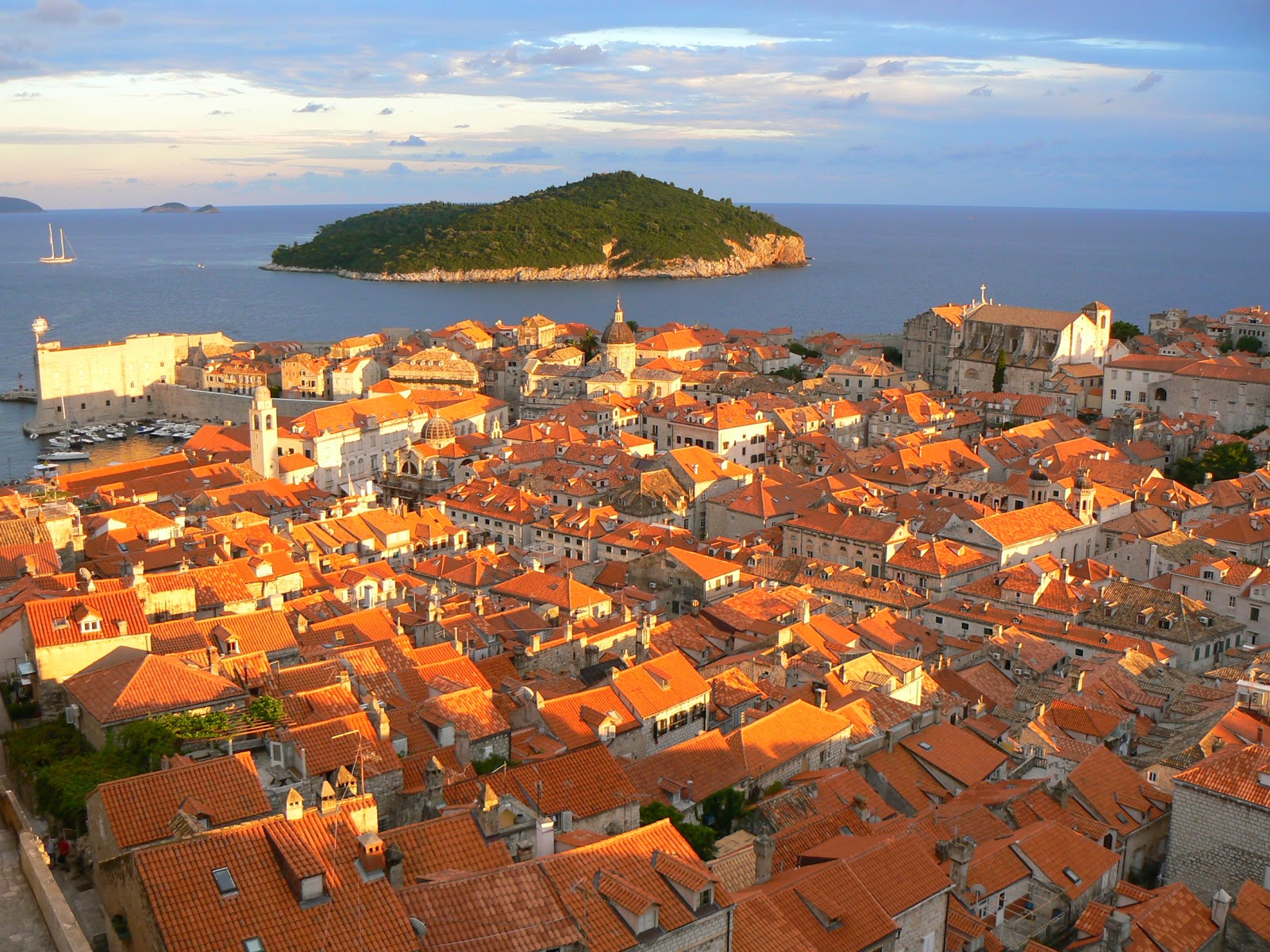
The medieval town is completely surrounded by a wall awesome. The wall, as the city, is in excellent condition, well maintained and clean, safe and quiet as well. Dubrovnik has many very beautiful nearby islands, Lokrum and Lopud as to name some famous. The landscape is idyllic between the edge of the beautiful Adriatic Sea and the slopes of the mountain. There is plenty of vegetation and trees that gave the name to the city (oak forest).
To enter the city there are two gates, the Pile Gate and the Gate Stari Grad (Old) and each entry has to climb the wall. Pile Since we entered the main street Placa (former Stradum) where we left the Franciscan Monastery, right Onofrio Fountain and near Spasa Church. We will climb the wall of almost two kilometers and 25 meters to go around the city. Walking the gravel road we reach the door plate Stari Grad and Luza Square, the most aristocratic of the city. During the walk we see the buildings and Baroque palaces and many locals.
Tip: I recommend doing the tour of the wall (70 Kuna: about 10 euros) upon entering the city to enjoy the unique panoramic view and appreciate during the course of the 16 towers that houses as well as various strengths, streets, buildings and discover beaches.
In Luza Square have access to the Sponza Palace and next to the Church of San Blas with the Statue of Orlando in front. Between the two buildings and in front of the door plate can not miss the Clock Tower. Like other noteworthy buildings have, to the left of the square (looking at the Clock Tower) through the Sponza Palace, the Dominican Monastery with a beautiful church. To the right of the square we can get closer to the Rectors Palace was the seat of government and the Cathedral of the Assumption, both are important monuments of the city.
To complete the tour we go to some museums like the Maritime Museum or the Ron Brown, and also take the opportunity to see the cloisters of San Domenico and San Francisco, the Orthodox Church or Synagogue. And if we leave the premises medieval one option is to approach the island of Lokrum is a national park with beaches that can be reached by boat in no time. It has many craft stalls for gifts and generally have much artistic value. I liked the paint boxes of artists, from 60 euros you can buy a book (to avoid stalls that are printed). Prices are more expensive than in Greece but cheaper than Venice to give an idea, but in no event is dirt cheap.
Where to eat Dubrovnik - Croatia? - There are many restaurants, bars, pubs and local fast food outlets to choose from. Prices vary widely depending on the category and location, but we can find many small local streets more economical and well priced.
Lot of coastal seafood and fish also like traditional dish sausage and meatballs available to eat, culinary cultures mixed Christian, Muslim and Jewish. I only had time to try waffles, ice cream and coffee, but very rich and well priced.
Places to Visit in Dubrovnik - Croatia - The usual list of recommendations is a mixture of personal experience and comments of guides and others.
1. Walls - The old town of Dubrovnik (Stari Grad) is completely surrounded by a massive walls of the XIIIth and are one of the most repeated images and popular Croatia. You can walk around inside after payment of 10 € (adults).
2. Plate (Stradun) - Main street of Stari Grad, which crosses the famous old town from the Pile Gate (where you can see the statue of St. Blaise, patron of the city) to Luza Square, where we can see the Clock Tower and the column Orlando. Most sights are concentrated in this street or nearby.
3. Sponza Palace - XVIth century palace that houses the State Archives and the Memorial Hall of the Defenders of Dubrovnik. The entrance to the Palace cost about 2 €. More info on the official website (translated with Google Translate). Highlights include the portico of six columns and manuscript collections.
4. Church of San Blas - Baroque church built in honor of the patron of the city. Stands the marble altar.
5. Franciscan and Dominican monasteries - Dubrovnik has two famous monasteries can be visited both house museums and its own faculty. In the Franciscan, in addition, is the third oldest pharmacy in Europe (in operation since 1391).
6. Rector's Palace - The former palace of the rectors, now a museum. Although it has suffered even explosions, has been tastefully restored.
7. Cathedral of the Assumption - Beautiful baroque cathedral. Highlights include the shrine with the relics of San Blas and altars.
8. Islet of Lokrum - This small island, located almost in front of Dubrovnik, ideal for a break of one day (can not stay overnight). Pines, olive trees, oaks and rocky beaches make up the beautiful National Park. Its naturist beach is popular, especially among the gay community. The return ferry costs about 8 €. There is hardly anything to buy food and no cars.
9. Great source of Onofrio - Huge circular fountain with 16 jets. The original building dates back to 1438. It is one of the most emblematic of the city and venue for groups and tours.
10. War Photo Limited - Photo gallery with impressive collections of conflicts. There is a permanent exhibition on the war on the Balkans and several other armed conflicts. Impress and awareness. You can find a guide in Castilian for the meaning of each photo. Approx. 4 € / adult
If you like this advice - Please Subscribe for future travel advice
Holiday or Tourism In Croatia - Places To Visit In Croatia - Travel Visit
What to see in Croatia? Places To Visit In Croatia - Travel Visit
It is an ideal destination for nature lovers and a paradise for nautical tourism. The best time to visit the country is in summer due to its ideal climate for many activities, such as excursions to national parks, water sports on their island ports.
In their cities can stroll through the medieval streets, know and be surprised with its stunning natural and cultural heritage. You cannot fail to visit the capital in its trolley or take a trip to the thermal region of Zagorje, north of Zagreb.
Usual tourist destination of Italian and German Croatia unusual speed progresses through the ranks of the country’s most visited by Europeans. From Spain the interest to know Croatia has grown by opening new lines of low cost flights from Madrid and Barcelona airports to the Croats. There is increasing interest in knowing whether Croatia cruises through its coasts, or paths and tracks through the cities of the Dalmatian coast.
Croatia Geographical location - It is a country in central Europe, consisting of a thousand islands, the archipelago of the Brijuni islands, is one of the most important points for their high degree of conservation of the natural environment.
In the southern and western Croatia has a coastline of 1,778 km. on the Adriatic Sea, with many ports and resorts. The relief is also made up of flat plains along Hungarian border, low mountains and highlands near Adriatic.
Croatia beach - Dubrovnik has become the ultimate symbol of the new Croatian big players in the European tourism.
Croatia map - The variety of tourism in Croatia goes beyond the beautiful cities of Dubrovnik, Zagreb and Split. It is an ideal country for a holiday, adventure sports, hiking, scuba diving, traveling by sailing the islands, enjoys your food or fine wines and routes to get lost in the magical places that history has left its streets.
The climate of Croatia - is a reflection of the variety of areas that form. In mountainous areas the climate is cold and dry, while on the Adriatic coast, the temperature is closer to the Mediterranean climate.
Being surrounded by major mountain ranges, Croatia is sheltered from the cold winters of Central Europe. The average temperature in Zagreb, capital of Croatia, is 27 degrees Celsius in summer while winter is usually 3 or 4 degrees above zero. The mountain range that stretches from north to south is responsible for establishing the differences.
In Zagreb, however, the temperature can reach up to 28 º C in July, the warmest month to go down to 2 ° C average in January.
It is best to go in the period extending from May to September if you want to enjoy the charms of the Adriatic coast. In winter, if you are interested and the rain does not bother too much, you can visit the coast without problems, but inside the snowfall is heavy, and the weather is cold weather.
Documentation Required to Visit Croatia - For stays of up to 90 days in Croatia, and for the citizens of the European community, the majority of the American countries and Japan, no visa is required. Suffice it to a valid passport.
For your safety, you should consult the list of countries whose citizens do not require visas for Croatia. In addition, we present a list of countries whose citizens can enter Croatia with the national identity of their country of origin. For more information, visit the website of the Ministry of Foreign Affairs of Croatia
In the industry stands Pula with its Roman amphitheater, although very popular are also Rovinig that seems to emerge from the waters of the Adriatic, or Porec, with its Basilica Eufrásica, declared World Heritage by UNESCO.
Further south, reaching Rijeca in the Gulf of Kvarner, Opatija is, the cradle of Croatian tourism, which was frequented by the early European travelers in the nineteenth century. In the Gulf are also some islands as Krek, Cres, Rab and Pag, they have noticed an increase in
Some Tourist attractions in Croatia - Major tourist destinations in Croatia are the coast, because of the great beauty of its landscapes, cities and islands. Around the coast there are places worth seeing, but some stand out for its monumentality and its natural wealth.
Zagreb the capital of Croatia - the Upper Town (Gornji Grad) is characterized by its ancient heritage, the Lower Town (Donji Grad) and the new city. In them: old streets, small squares, cobbled, the church of San Marcos (XIII century), the palace of Ban, the Dolac market, the Museum of the City of Zagreb, the Museum of naive art and the museum of contemporary art, Ilica street, the square of Ban Jelacic-, Tkalciceva street and café terraces, the park Maksimir, the cemetery Mirogoj.
In Dubrovnik (the pearl of the Adriatic and World Heritage Site by UNESCO)- the walls that offer 2 km of walks, Franciscan and Dominican monasteries, Lochrum Island, visit the archipelago Elaphite.
In Split, second largest city of Croatia's Adriatic coast, the Roman Emperor Diocletian's palace, the ride "Riva", Mestrovic Gallery.
In Zadar - a medieval town: remains of the old People's Square, the palace Ghirardini, the municipal Loggia, Church of San Simeon and San Simeon's sarcophagus, the church of San Donato, the Archaeological Museum and the Museum of religious art, the city market.
Zadar, a city that became capital of Dalmatia, is the reference point for travel to amazing places like the island of Dugi Otok or Kornati Islands.
Sibenik, following the coastline, with the Cathedral of Santiago, another World Heritage Site.
Trogir, before arriving in Split is also a World Heritage Site. Split it now capital of Dalmatia, was honored equally with the same appreciation for its historic center and Diocletian's Palace, one of the most visited monuments in Croatia.
Leaving Split, the main destinations are the Makasrca Riviera, a spa town, the Neretva River Delta, the islands of Brac and Hvar, the latter a World Heritage Site, Korcula and Dubrovnik course, also a World Heritage Site and famous for its beauty and architectural monuments.
Inside the country's capital Zagreb and Plitvice Lakes are the most sought after, well ahead of other, better known by the traveler for Croatian abroad, such as Osijek and Varaždin.
Other tourist attractions are -
The small town of Korcula
Trogit City (World Heritage Site by UNESCO)
Coastal towns in Istria, in central Dalmatia and South Dalmatia
The National Park Paklenica
The National Park Plitvic
If you like this advice - Please Subscribe for future travel advice
Subscribe to:
Posts (Atom)